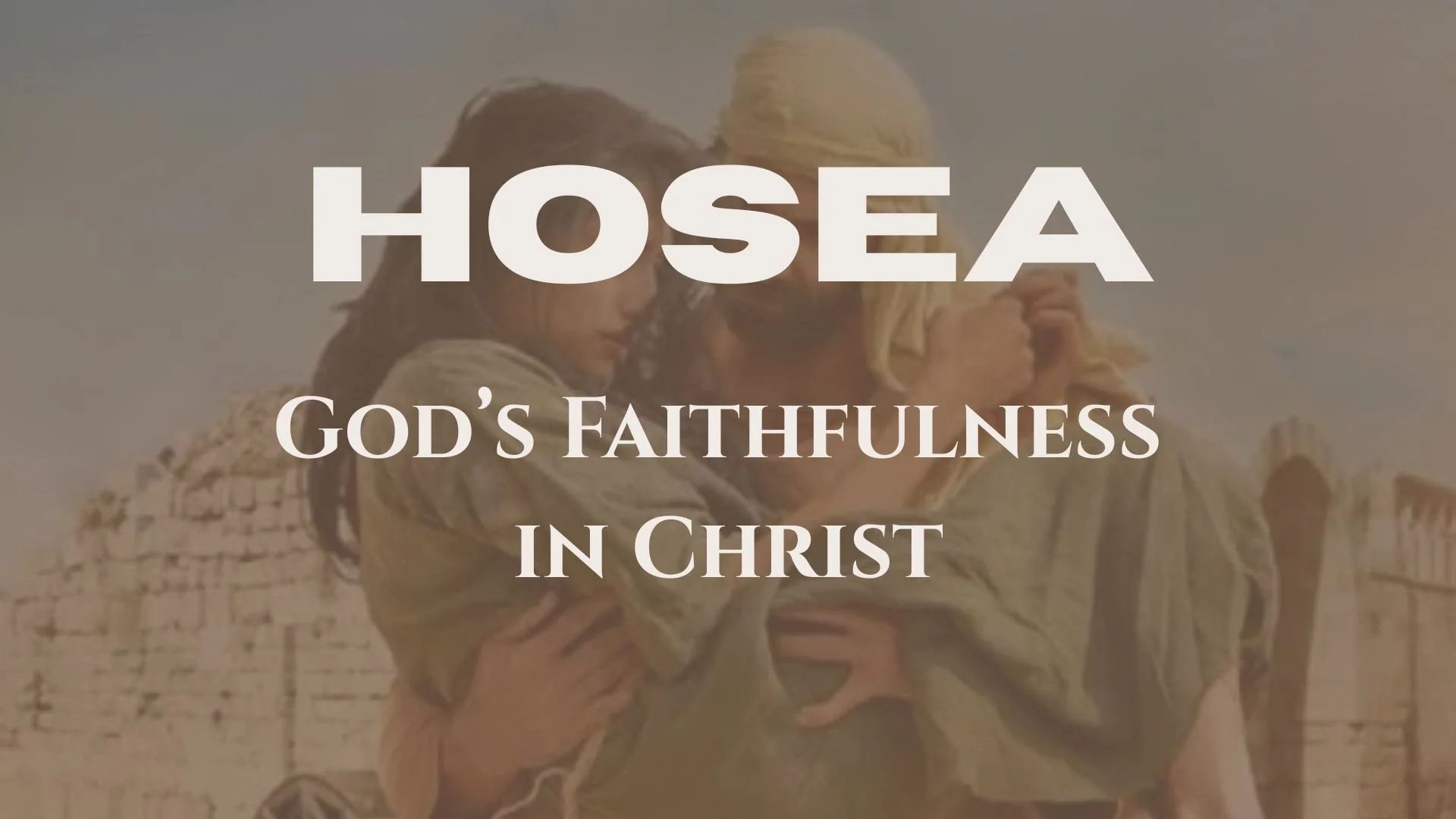
Hosea: God's Faithfulness in Christ - The Holy One

Sunday, I mentioned how God used Isaiah 1:2 in my life. God mourns that He has raised children and they have rejected Him. While I’m thankful that God knows what it’s like to have children rebel and follow their own counsel, the real lesson for me was that I’m that child. As good as I tell myself that I am, I’m still a rebel at heart, and any growth and fruit of righteousness in my life is the fruit of His grace. In those tender moments before God, my heart shifted from anger and judgment toward my child, to one of humility and grace. As I repented of my self-righteousness, I was able to extend the grace of God to my child as a fellow recipient of God’s mercy.

As we work through Hosea 11, we’ll learn more about God’s mercy and find hope in His righteousness. Join us as we worship the One who offers us mercy and grace in our time of need. See you Sunday!

Tim Locke
Hosea: God's Faithfulness in Christ - True Israel

How would you define the ideal soldier? Is it his courage? His loyalty? His obedience to orders? I’m reading Ghost Soldiers, the story of the 1945 raid on a Philippine POW camp where 514 American soldiers were liberated by the Army 6th Ranger Battalion. It’s a daring rescue by very courageous men who knew they may never come home. But does that make them the ideal soldier? What about Corporal Desmond Doss, a Seventh Day Adventist who entered WW2 with the conviction he would not carry a weapon. Yet, in one battle, without a weapon, he rescued seventy-five soldiers pinned down by the Japanese army in Okinawa. He crawled toward the wounded, under direct fire, and dragged them back to the 400ft cliff, lowering them down to safety. Because of his dedication to his fellow soldier, his selfless courage and deep conviction, he was awarded the Congressional Medal of Honor. 

Whatever makes one the ideal soldier, we know what would make a person the ideal child of God: righteousness! As we have worked through Hosea, it’s become obvious that the people of God have fallen short of that ideal. But in our text this week, Hosea 11, we have hope in the One who would come and be a faithful Son, a model member of God’s family, the true vine that would produce righteous fruit. Join us Sunday as we worship Jesus, the True Son!

Tim Locke
Hosea: God's Faithfulness in Christ - Repent for Healing

Have you ever made promises to God? “God if you get me out of this jam, I’ll go to church every Sunday?” Or maybe, “God if you bless me financially, I’ll give more to the church.” Or, “If you give me a good grade on this test, I’ll study harder next time.” These are manipulative prayers that in truth we don’t have the power to fulfill. I’ve knelt at many an altar, confessing sin, surrendering myself to Christ, making promises that I want to fulfill, but remained powerless apart from gospel grace. Living righteous lives isn’t something that we can produce by will, discipline or grit. We need the powerful Spirit to bear the fruit of righteousness in us as we seek the Lord. We need His transforming grace as we repent of sin and move by faith into gospel driven obedience. 

In our text God’s people were deceived by their own hearts. Their confidence in themselves twisted their hearts, blinding them to their evil, which led to severe discipline from God. While we are not under the Mosaic national covenant, we are much like Israel. God does not and has not changed. What He demands, He supplies, grace upon grace in Christ. Join us as we worship Him.

Tim Locke
Hosea: God's Faithfulness in Christ - Misshapen Image-Bearers

So, Sunday I mentioned that I am listening to Tolkien’s Hobbit and Lord of the Rings series. I grew up making long trips to Michigan to visit extended family in Battle Creek. During that 15-hour trip in a 1977 GMC Suburban with three boys wrestling in the back, my parents would play the Hobbit over the stereo system. It was good for eight hours of quiet, spellbound children. If you’ve read the books or watched the movies, then you know that Gollum was once a normal Hobbit named Sméagol. He was a descendent of early hobbits known as Stoors, but the one ring consumed him, changing his mind and his physical form, making him a detestable, unrecognizable creature. In fact, that became the description of him, the creature Gollum.

It illustrates what God says in our text about His idolatrous people, they…became detestable like the thing they loved. This is how idolatry functions. It takes image-bearers of God and distorts them into misshapen creatures. While it’s a warning to us, urging us to examine our hearts, it’s a reason for great celebration to think of Christ conforming us to His likeness. Join us as we look at the text and worship our righteous Lord.

Tim Locke
Hosea: God's Faithfulness in Christ - Meaningless Festival

Our text this week, highlights the annual camping trip that God's people engaged in called the Feast of Booths. It was the last of the seven celebrations of the year where God's people would gather in Jerusalem, live in tents, and spend the week making offerings to the Lord, celebrating God's provision in the harvest. Imagine the conversation the week before in a typical Jewish home, where the wife would rather "glamp." Remember, there was no Camping World. Recognize that their hearts weren't in this celebration. It was a formality, a necessary ceremony that had been corrupted. Not only did Israel (northern nation) travel to Jerusalem because it was in Judah, but they saw God as one of many gods to be thanked for the harvest. Israel had corrupted itself with the Baals of the pagans and were defiled, unclean. In the context of Hosea's marriage to Gomer, it would be like celebrating Father's Day with the children from her lovers in attendance. She had to do it, because it's Father's Day, but it was an awkward moment to be sure.

Yet, the text leads us to Christ! Join us as we worship the One who redeems, purifies, and provides for our salvation.

Tim Locke
Hosea: God's Faithfulness in Christ - Doubled Minded

Our culture has created ethical non-monogamy or polyamory. For a long-time the world has engaged in polygamy, the practice of one man having multiple wives, or polyandry, the practice of one woman having multiple husbands. We see this in the Scriptures where Abraham, Jacob, and David had multiple wives even though God condemned the practice. But today’s culture has rejected monogamy (one man with one woman for life), blowing through the idea of a covenant marriage. Ethical non-monogamy, or polyamory, concludes that if the spouse knows about the other relationships and agrees to the practice, then having multiple partners remains ethical. Beyond the theological implications and fallacies, the ethics of it violate God’s clear instruction for marriage as an earthly institution that mirrors our spiritual and exclusive union to God through Christ. This is in fact why God uses Hosea’s broken marriage as His illustration of Israel’s unfaithfulness. Israel is spiritually polyamorous.

Our text this Sunday presents a deeper look at Israel’s spiritual non-monogamy. Israel added God to their lives but had not reserved themselves exclusively for Him. For them, God functions as one among many. In our text, God exposes further evidence of their deism which has led them to polytheism (multiple gods) and the tragic results of breaking covenant with Him. While it’s tragic, we hope in and walk united to Christ, who lived in spiritual monogamy with His Father. Join us as we worship and learn from Christ.

Tim Locke
Hosea: God's Faithfulness in Christ - Refusing Treatment

One of my favorite channels presents videos of vehicles that are taken to a service center with customer complaints. The narrator says, “Customer complains he hears a clunk when he hits the brakes.” Then the videographer shows that the customer’s brakes are completely worn out, grinding the rotors to powder. What’s fascinating is what is said next, “Customer refused service and drove away.” Why would the customer refuse service? Why would they drive away knowing the danger? It’s scary to think that people are driving around with cars in this condition.

In our text this week God says that He wants to heal Israel, but they stubbornly refuse to return to Him. They don’t want to give up their sin, but more importantly they are convinced that they can solve their own problems: we’ll remove the king; we’ll turn to others for help; we’ll turn to Baal. The one thing they won’t do is turn to the Lord for help, even though He longs to heal them. Join us Sunday as we worship the One who came to heal our hearts!

Tim Locke
Hosea: God's Faithfulness in Christ - Consistent Love

Our text this week exposes the rom-com drama of God’s people. We engage, we disengage, then in desperation, we reengage. We’re fickle and dramatic. We treat God like a plate that we need to keep spinning, a meter we need to keep running, a deity we need to keep satisfied lest we incur His anger and lose His benefits. Israel runs back to the Lord for a quick fix, inserting a few more coins in the meter. God groans, saying, What shall I do with you, O Ephraim? What shall I do with you, O Judah? Your love is like a morning cloud, like the dew that goes early away (Hosea 6:4). 

What does God desire? He says, For I desire steadfast love and not sacrifice, the knowledge of God rather than burnt offerings (Hosea 6:6). How do we change this cycle and offer steadfast love to God? Join us Sunday as we worship the One who loves God with all His heart, soul, and might.

Tim Locke
Hosea: God's Faithfulness in Christ - Playing Games

So many couples enter marriage because the other person makes them happy or gives them what they want. In the early days of the relationship, they mold themselves into the person they need to be to win the person. Then, after time goes by, they stop being that person or doing the things that won that person's heart. It’s not long before they resent the very person, they said that they loved. Now both parties are disillusioned with the relationship and either a new foundation of selfless love will be built, or the marriage will end. When I married Debbie, I wanted to be someone’s knight in shining armor, and she my damsel in distress. Ultimately, I wasn’t leading her or my family, and I wasn’t loving her, I was using her to maintain my knighthood. Thankfully, God led me to repentance and our marriage flourishes today.

In our text this week, we learn that God’s people were playing games with Him. During the week, they were living according to their own desires, worshipping the Canaanite gods, engaging in sinful practices, building wealth, and making political alliances with Assyria. Then on Sunday they would bring God their sacrifices, attempting to gain His favor, molding themselves in the moment to what they thought He wanted. They were trying to use Him, but they weren’t really seeking after Him. They would soon discover that God cannot be used. He doesn’t relate to us in these transactional terms, but He gives grace to the humble. Join us this Sunday as we worship the One who won us God’s favor through His obedience and liberates us to walk humbly with Him.

Tim Locke
Hosea: God's Faithfulness in Christ - Like People, Like Priest

We have heard the importance of leadership and would expect to hear the phrase, "as the leader goes, so goes the people” or “as the father or mother goes, so goes the home.” In our text, Hosea 4, we have a curious phrase, like people, like priest. In other words, the priests are joining the people in their idolatry and immorality. How does this happen? Why do leaders fail to uphold the righteousness of God before the people? What causes them to compromise the glory of God for the shame of the world? 

Back in the 1970’s, the Presbyterian Church in the United States (PCUS) was beginning to compromise their Biblical convictions, specifically on the doctrine of inerrancy and the role of women in the church leadership. In addition, there was a movement to join the already liberal United Presbyterian Church (UPC). Ministers and churches were faced with a difficult decision: leave the denomination, walking away from their health insurance, pensions, and potentially their buildings, all of which were held by the denomination, or remain faithful to Scripture. 

Dietrich Bonhoeffer faced a similar situation as the state church of Germany surrendered itself to the Nazi regime. In 1934, a group of faithful ministers signed the Barmen Declaration, opposing Hitler and the state church. A few thousand ministers left the state church, leaving their positions and pensions to remain faithful to Christ and resist the Nazi regime. Many of them knew that they were signing their death warrant.

Both situations show the courage of men like Hosea, who stood against the compromise of their peers and resisted the evil of their day. But the story isn’t about Hosea or the unfaithful priests; it’s about our faithful, loyal High Priest, who leads us into a knowledge of God. Join us as we worship and hope in Him.


Tim Locke